InsightsSeptember 23, 2026
The rise of B2B invoice payments
Here's how "Buy Now, Pay Later” is taking over the B2B market.

Clara Porath
Content & Communications Manager

Buy Now, Pay Later (BNPL) has established itself as one of the most popular payment methods in global e-commerce. And in many European markets Pay in 30 Days or invoice-based payments are among the preferred solutions. But until now, the focus has been almost exclusively on B2C.
In B2B e-commerce, however, BNPL has long remained a niche offering. That’s now changing. A growing number of payment providers are recognizing the gap and launching specialized invoice-based payment models for business customers.
So what makes B2B invoice-based payments unique, and how much market potential does this BNPL solution actually hold?
B2B buyers and invoice‑based payments in e‑commerce
1. Emotion vs. reason
B2C shoppers make purchases based on both rational considerations and emotional impulses. B2B buyers, on the other hand, follow an almost entirely rational decision-making process. Their purchasing needs are predictable, planned, and driven by clear business objectives and economic factors.
2. Multiple stakeholders
B2B buying decisions are rarely made by a single person. Instead, they typically involve multiple stakeholders across complex procurement processes.
3. Long customer lifetime value
Unlike B2C buyers, whose relationships with merchants can be short‑lived, B2B customers often seek long‑term partnerships. This stability is a core pillar of the B2B business model.

4. Flexible pricing
B2C shoppers usually pay standardized prices. B2B buyers, on the other hand, expect individualized pricing based on factors such as industry, order volume, contract terms, or location.
5. Delivery reliability
In B2C, “fast” delivery is usually the main expectation. In B2B, delivery precision is what matters: orders must arrive exactly when they are needed to align with business operations.
6. Long payment terms
While B2C payment terms typically range from 14 to 30 days, B2B transactions follow different timelines. Depending on the industry, payment terms of up to 120 days are common and often expected.
7. High, fluctuating order values
The average order value (AOV) in B2B e‑commerce is often seven times higher than in B2C. Consequently, many B2B BNPL providers support invoice limits of up to €100,000.
As you can see, the entire decision‑making context for B2B buyers differs fundamentally from the B2C environment. Here’s a quick overview:

Because of these differences, business customers don’t want to be treated like consumers.
They expect the same ease and convenience in the buying experience – but with processes, pricing, and payment methods that match the complexity of B2B commerce. And that includes one of the most important steps: the payment itself.
B2B invoice payments: a powerful alternative in e‑commerce
For years, traditional trade credit was the go‑to financing method for business purchases. But compared to modern BNPL solutions, these credit options often fall short. Especially in terms of speed, flexibility, and convenience.
Trade credit vs. B2B invoice
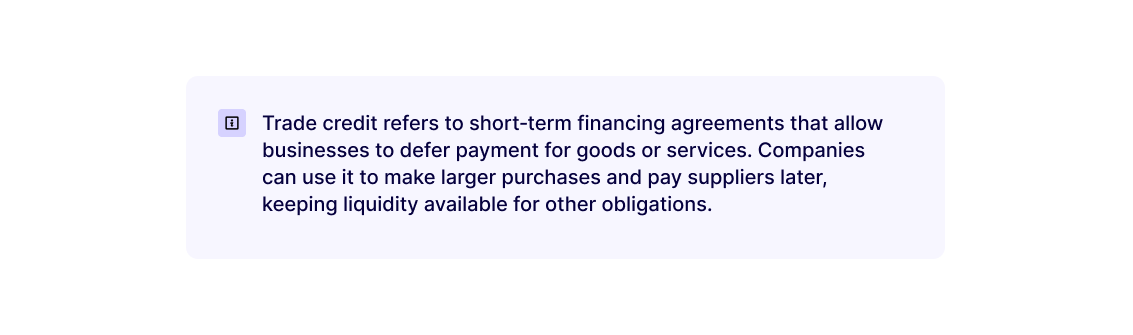
Traditional trade credit often comes with cumbersome application processes, extensive credit checks, and payment terms that simply don’t meet the needs of many businesses.
This is especially challenging for SMBs. A European study estimated the financing gap for those in the Eurozone at €400 billion in 2019 – highlighting just how difficult access to capital can be.
This is exactly where B2B invoice‑based payments can close the gap.
For online purchases, invoice‑based BNPL is significantly more flexible, convenient, and frictionless giving businesses fast access to the goods they need.
B2B invoice payments as core component of Digital Self‑Service
For years, many European B2B buyers have been pushing for more digital leeway – calling for a seamless, end-to-end “digital self-service”. A 2020 McKinsey study illustrates this shift clearly:
- Only 20–30% of B2B buyers still want personal interaction with a sales representative when purchasing online.
- 96% of B2B buyers would complete a purchase in a fully digital self‑service model – and a slim majority would be comfortable spending $50,000 or more without human contact.
All of this points to a fundamental shift in B2B e‑commerce. After all, digital self‑service –meaning an end‑to‑end online purchasing journey without direct sales interaction – is driven by a new generation of millennial buyers.
And few payment methods fit this world better than fast, convenient, and frictionless Buy Now, Pay Later solutions such as B2B invoice payments.

B2B invoice payments: A high‑potential market opportunity
Despite the enormous market potential, B2B adoption still lags far behind B2C. But that gap is closing quickly. Invoice‑based BNPL is emerging as a highly attractive alternative to traditional financing models – and is gaining traction in the competitive landscape traditionally dominated by banks.

Would you like to offer B2B invoice payments for your business?
Find out how to integrate B2B invoice-based purchasing into your checkout process in a simple, secure and flexible way.